
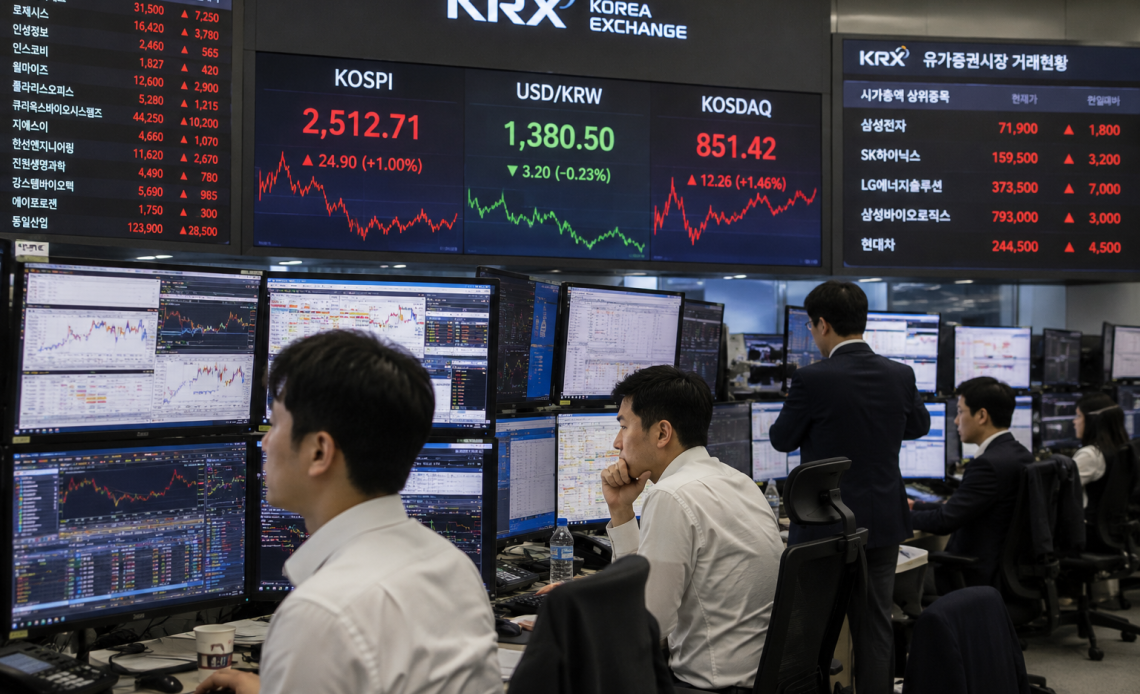
South Korean stocks ended their worst week in more than three months on Friday, capping a turbulent stretch that has also prompted comparisons between the country’s benchmark equity index and the meme-stock frenzy that gripped global markets in 2021.
The benchmark KOSPI index closed down 519.09 points, or 5.81%, at 8,411.21 after tumbling as much as 9% earlier in the session, triggering circuit breakers for the second time this week.
The move marked the fifth time this year that trading curbs have been activated on the benchmark and only the 11th such instance in the index’s history.
The KOSPI ended the week down 6%, its steepest weekly decline since early March, when the Iran conflict rattled global financial markets.
The pullback comes after an extraordinary run.
The benchmark surged 76% in 2025 and has nearly doubled in value so far this year, making it the world’s best-performing major stock market.
Chip-heavy index and retail interest amplify meme-like market swings
The turbulence began when the KOSPI plunged 10% on Tuesday and has since swung wildly between sharp losses and gains, at times reversing course within the same trading session.
Friday’s decline came after the KOSPI had rallied 5.4% and 3.3% in the previous two sessions.
Strong earnings from US memory-chip maker Micron had briefly steadied investor sentiment, but those gains proved short-lived.
“Today’s slump can be mostly explained by high volatility amid concentration in the chip sector, while worries about memory demand declining are a bit excessive,” said Han Ji-young, an analyst at Kiwoom Securities.
The concentration of the index in semiconductor stocks has increasingly magnified market movements.
Samsung Electronics and SK Hynix now account for nearly 60% of the KOSPI’s market capitalisation, making swings in investor sentiment toward artificial intelligence and memory chips capable of moving the entire market.
Analysts say another major driver of volatility has been the growing influence of retail investors.
Morgan Stanley said earlier this week that the benchmark’s strong rally had attracted a new wave of retail investors, boosting liquidity but also increasing volatility.
The KOSPI has closed up or down by at least 5% on 20 occasions this year, compared with just two instances in 2025.
The sharp intraday swings have prompted comparisons with the meme-stock mania that surrounded companies such as GameStop and Bed Bath & Beyond in 2021.
“The Kospi in 2026 is starting to trade with meme-like muscle,” said Hebe Chen, a market analyst at Vantage Global Prime in Sydney, in a Bloomberg report.
“With Samsung and SK Hynix carrying outsized influence, and leveraged products mechanically amplifying every move in a market with too few obvious targets for that money to chase, each swing in AI sentiment can quickly become an index-level event.”
Leveraged ETFs add to volatility
Single-stock leveraged exchange-traded funds have emerged as a focal point in recent weeks.
The products have become increasingly popular among South Korean retail investors and have contributed to the market’s amplified moves through mechanical rebalancing.
The country’s financial watchdog recently expressed regret over approving such products, adding to concerns that recent gains may have been driven partly by technical flows rather than fundamentals.
Single-stock leveraged ETFs often require large adjustments to positions when markets move sharply, intensifying both gains and losses.
The KOSPI has “such a high beta to the rest of the market, reflecting strong retail participation and concentration in a small number of names that at times are trading with volatility similar to what you might associate with meme stocks, even though they are trillion-dollar companies,” said Matt Toms, head of cash equity execution for Asia Pacific at Barclays Plc in the Bloomberg report.
According to Goldman Sachs estimates, a 5% move in the Korean market can trigger approximately $4.7 billion in ETF rebalancing flows as option dealers adjust their positions.
That figure represents roughly one-eighth of average daily trading volumes in Korean equities.
“Anything that moves the Nasdaq by 2% will move the Kospi by 10%, because you just have this massive amplification of volatility in Korea because of retail investor activity,” said Alex Redman, chief equity strategist at CLSA Singapore in the Bloomberg report.
Analysts remain constructive despite turbulence
Despite the heightened volatility, several strategists remain optimistic about the market’s longer-term prospects.
Morgan Stanley maintained a base-case target of 9,000 for the KOSPI and projected the index could climb to 10,500 in a bull-market scenario, implying nearly 25% upside from current levels.
The firm cited still-strong fundamentals for memory-chip makers and artificial intelligence-related stocks.
The brokerage also outlined a bear-case scenario in which the index falls to 6,500.
“Market volatility has entered an expansionary phase,” the report said.
“The diversification of products and the broadening of the investor base bring the positive effect of increased liquidity, but at the same time are factors that amplify volatility.”
As a result, Morgan Stanley recommended a barbell strategy, maintaining exposure to growth stocks while increasing allocations to more defensive sectors such as financials, defence, healthcare, and premium consumer goods.
The post Kospi suffers worst week since March: Why has the index turned so volatile? appeared first on Invezz