
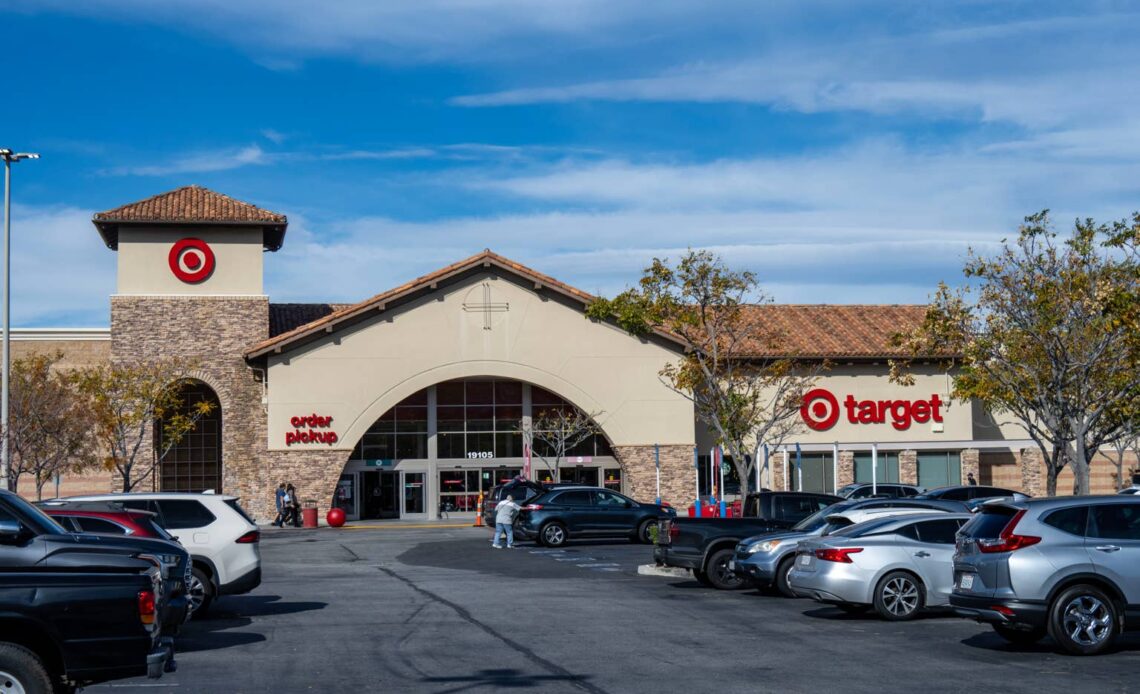
Target is seeing customers spend cautiously in two key merchandise categories, despite experiencing stronger sales in recent months.
In its latest earnings report, Target revealed that its comparable store sales rose 4.6% year over year in the third quarter of 2026.
Overall foot traffic in its stores also climbed 7.2% year over year during the quarter, according to a recent Placer.ai report. Repeat shoppers helped drive this gain, as 48.2% of Target’s visitors came at least twice a month on average and 8.8% came five times or more — both three-year highs.
“The chain has cut prices on more than 10,000 frequently purchased items and focused on a more consistent in-store experience, moves that give regulars more reasons to come back,” wrote Ephraim Fruchter, insights content writer at Placer.ai, in the report. “And for a chain that spent much of 2025 trying to win shoppers back, repeat visits provide further evidence the effort is taking hold.”
Target flags disappointing home and apparel sales performance
Despite recent signs of stronger consumer demand, Target is struggling with weak sales growth in its home and apparel categories.
In its earnings report, it revealed that it earned about $4 billion in home furnishings and decor net sales during the third quarter, slightly up from roughly $3.9 billion in that category a year ago.
It also earned about $3.69 billion in apparel and accessories net sales, down from roughly $3.8 billion in the same quarter in 2025.
The slow sales growth comes after Target announced in September that it was lowering prices on nearly 2,000 home, apparel and accessories items.
On a media call with reporters on Nov. 17, Target CEO Michael Fiddelke said that the company is “not satisfied” with its performance in both categories.
Read more: Target raises price of annual grocery deal for holiday shoppers
“To be clear, we have more work to do, particularly in home and apparel, where we’ve made progress but are not satisfied with performance,” said Fiddelke. “In both categories, we know where we need to improve. We’re aligned on the actions required, and we’re committed to doing the real work to deliver the level of style and value our guests expect from us.”
He said that Target has “momentum in parts of each of those categories,” but it needs “more.”
Cara Sylvester, chief merchandising officer at Target, said on the call that the company’s slight sales gains in its home category follow its decision to sharpen its focus on “the fundamentals” this year. This includes an increased investment in reliability, value, and large-scale category resets.
“In Q3 (the third quarter of 2026), we tackled bedding, we tackled bath, we tackled kids’ home,” said Sylvester. “Those are areas that are all performing really well, and there’s more work to do,” emphasizing that the company is working “category by category.”
She also said that within Target’s apparel business, several categories are growing in sales: men’s, kids, women’s swim, and young contemporary. However, two are falling behind.
“We have two categories in particular that we’re working through: women’s and shoes,” said Sylvester. “Those are two larger categories. For there, we have thoroughly diagnosed the business, and we are working on getting back to some of our fundamentals: fit, quality, design, value.”
“Getting that right magic mix correct is really important,” she continued. “The teams are focused on that. You’ll start to see some of that product coming through as we head into the new year.”
Trevor Srednick / Getty Images
Target bets on holiday shoppers as consumer spending shifts nationwide
Target is facing sales challenges in home and apparel at a time when U.S. consumers are cutting back their discretionary spending amid economic headwinds such as inflation and high fuel prices.
A survey from McKinsey & Company in August found that 45% of U.S. consumers planned to spend less on home decor in the next three months, while 38% expected to spend less on apparel and 36% planned to spend less on footwear.
Sucharita Kodali, a principal analyst at Forrester, warned on the “Marketplace Morning Report” podcast in August that the U.S. consumer is “very stretched.”
“We have one of the lowest rates of consumer confidence that we’ve had pretty much since World War II,” said Kodali. “And what that means is that you essentially have a K-shaped economy.”
More Retail:
- Target raises price of annual grocery deal for holiday shoppers
- Publix faces uphill battle as customer behavior shifts
- Home Depot drops generous offers as customers grow harder to win
“You have consumers at the top end, generally able to spend, and they are [buoying] the retailers that are doing well,” she continued. “And then you have a lot of consumers at the lower end who are either cutting back on the amount that they’re spending, (or) they’re more careful about what they’re spending.”
As consumers grow more cautious about their spending, Target is betting on the holiday season to lift its sales.
The retailer has dramatically expanded its holiday gift assortment this year, focusing on offering these items at more affordable price points.
“We’re offering more than 8,000 new gifts across our assortment compared to last year, with more than half exclusive to Target,” said Fiddelke during the media call. “This includes more than 1,000 toys under $10, family pajamas starting at $10, holiday decor starting at $5, nearly 80% of our own brand holiday food and beverage items priced at $5 or less.”
Sylvester said that Target is already seeing customers respond to this assortment “across the board” within the first few weeks of the fourth quarter.
Related: Target gains ground in keeping customers from fleeing to Walmart