
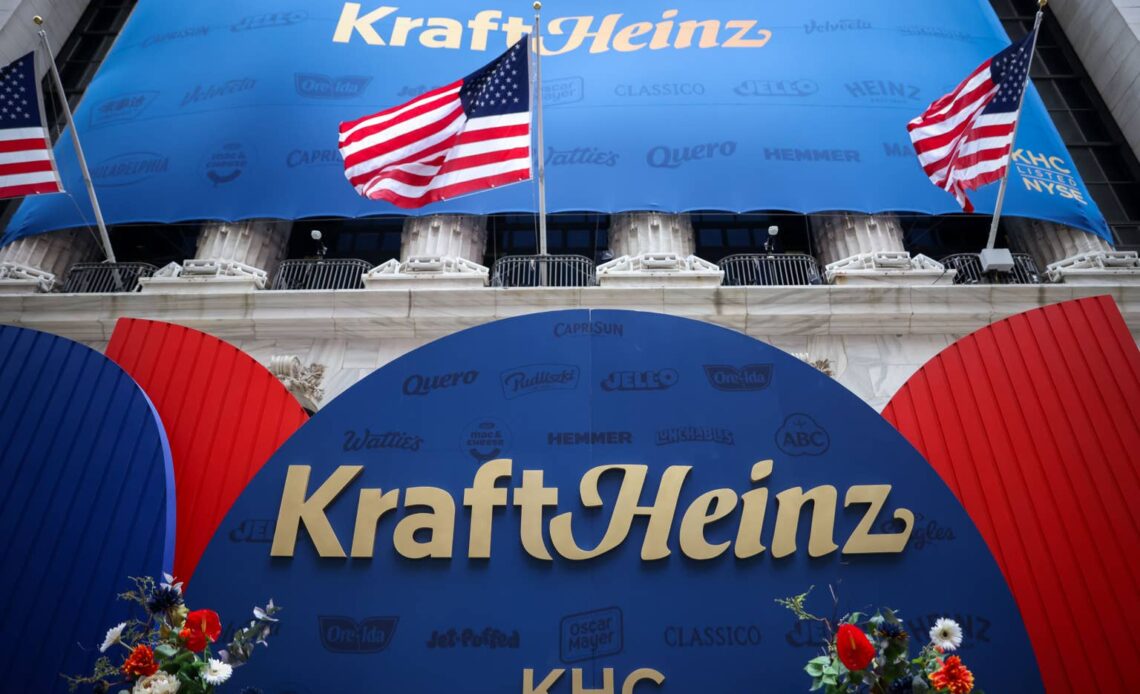
Heinz ketchup and Kraft Mac & Cheese are pantry staples across America, and Berkshire Hathaway still owns more of the company behind them than anyone else.
In January, a regulatory filing cleared the way for Berkshire to sell almost its entire stake in Kraft Heinz (KHC). Through September, Berkshire held on anyway.
Berkshire owned 325,634,818 Kraft Heinz shares on Sept. 30, according to its latest 13F filing. Its third-quarter report shows it still owns 27.5% of the food maker, enough to keep it the largest shareholder.
Those shares were worth nearly $30 billion in early 2017, when Kraft Heinz traded above $90, Seeking Alpha noted. By March of this year, CNBC valued the stake at $7.9 billion, and at early-November prices tracked by Stock Analysis, it was still worth roughly $8 billion. More than $21 billion of market value vanished along the way.
Also read: Bill Ackman’s $14 billion bet beyond the Magnificent 7
Kraft Heinz is one of America’s largest packaged-food companies. When an owner of more than a quarter of its shares hesitates, every other shareholder has to price in that hesitation.
Abel filed to sell, then stopped
The January filing landed while Kraft Heinz was preparing to split into two companies. Buffett had publicly criticized that plan when it was announced in September 2025, CNBC reported.
Kraft Heinz’s new CEO, Steve Cahillane, paused the breakup in February and chose to fix the business instead. Berkshire’s CEO, Greg Abel, backed the move and told CNBC that Berkshire filed the registration to be ready if it ever decided to sell. “But it’s not that we’re going to take any immediate action currently,” he said.
Abel has also called Kraft Heinz a disappointing investment, so the decision to hold is not sentimental. It looks more like a calculation, and Berkshire’s own books show why.
Bloomberg / Getty Images
Berkshire’s books value the stake above market
Two numbers drive this story, and they are easy to confuse. Market value is what Berkshire’s Kraft Heinz shares are worth on the stock market. Book value is the accounting figure Berkshire carries on its balance sheet.
Because Berkshire uses the equity method, that book value moves with Kraft Heinz’s earnings, dividends, and write-downs, not its stock price. On Sept. 30, book value stood at $8.8 billion, while market value was $7.4 billion, Berkshire’s filing shows.
More Investing:
- How smart investors use ETFs to legally bypass IRS wash sale rules
- Vanguard renames key funds to highlight Morningstar benchmarks
- Popular ETFs carry hidden tax rules that surprise retail investors
Selling at that price would have forced Berkshire to report a pretax loss of about $1.4 billion, before any discount a buyer would likely demand for a block this large. That is a hit to reported earnings, not a cash bill. Berkshire would still pocket billions from a sale, and the loss would bring its books in line with the market.
Berkshire said no write-down was required this quarter. Still, it warned that a change in its intentions “may result in the recognition of an impairment loss.” That charge would also be non-cash, but it would dent earnings, on top of past charges that include roughly $5 billion pretax in 2025.
The actual cash flows the other way. Kraft Heinz sent Berkshire $131 million in the third quarter alone, the filing shows.
Berkshire is also waiting as an outsider. Its representatives left the Kraft Heinz board in May 2025, and the filing says its information now comes only from public disclosures. The largest owner reads the same reports as everyone else.
What the stock offers today
For ordinary shareholders, Kraft Heinz stock has been just as disappointing. The stock’s September value works out to roughly $23 a share, about three-quarters below the $90-plus level of early 2017.
What it offers now is income. Berkshire’s quarterly check works out to about 40 cents a share, or $1.60 a year, roughly a 7% yield at September’s price.
That yield has a catch. Sales growth is still a promise. Buying the stock today is a bet that the turnaround shows up before patience runs out.
Wall Street is not convinced yet. The 19 analysts tracked by Stock Analysis rate Kraft Heinz a Hold on average, with a 12-month price target of $25.15. That sits only about 2% above where the stock traded in early November.
Recent calls lean cautious. UBS raised its target to $26 but kept its rating Neutral, while JPMorgan cut its target to $23 and rated the stock Underweight. In plain terms, analysts want proof before they pay up.
The turnaround now has a deadline
Berkshire, ordinary holders and Wall Street are all waiting on the same thing, and it got clearer this month. At its Nov. 12 investor day, Kraft Heinz said it expects to return to top- and bottom-line growth in the second half of 2027, CNBC reported.
Cahillane has steered an extra $700 million into the business and hired 400 people since January, according to the report. “I saw a lot that was fixable,” he told CNBC.
That target now does double duty. It is Kraft Heinz’s promise to investors, and it is also a checkpoint likely to shape Berkshire’s next move.
- Growth on schedule could lift the shares and shrink the gap between book value and market value, letting Berkshire either stay comfortably or exit with a smaller reported loss.
- A missed target would undercut the turnaround Abel endorsed and make a writedown harder to avoid.
- Flat results could keep the dividend flowing, but they would also leave a ready seller hanging over every rally.
Patience has a price tag
Read together, Berkshire’s filings and Abel’s comments sketch a clear case for waiting. Book value, a steady payout and a fresh growth target all point the same way, at least for now.
The lesson extends beyond a single food company. When a large holder carries a stake on its books at an above-market price, selling it turns a paper gap into a reported loss, so waiting can look cheaper than it is.
For other Kraft Heinz shareholders, that creates an odd dynamic. The stock’s biggest owner has a strong accounting reason to stay, yet it has also filed the paperwork it would need to leave.
That is why the second half of 2027 matters beyond sales. It is the milestone that could decide whether Berkshire becomes a patient partner again or the seller the market feared in January.
More Stocks News
- Goldman Sachs sends a signal investors can’t ignore for 2027
- Jim Cramer just sent a strong warning about the Anthropic IPO
- 3 under-the-radar picks Wall Street’s sharpest minds like now
- The IRS just made a change to retirement savings limits for 2027