
OpenAI’s path to public markets has tightened around a single benchmark its CEO refuses to negotiate below.
The maker of ChatGPT has raised approximately $190 billion in private funding to date and positioned itself at the center of a generational technology shift.
Investors have been watching closely since the company filed a confidential draft S-1 with the Securities and Exchange Commission on June 8, 2026.
That public debut may not arrive as soon as expected, due to OpenAI’s insistence on a $1 trillion valuation.
Sam Altman draws a line at $1 trillion for OpenAI
OpenAI is leaning toward pushing its initial public offering into 2027 rather than listing at a valuation below $1 trillion, The New York Times reported.
The company’s advisers presented chief executive Sam Altman with a stark choice: Accept a lower price and list in late 2026, or hold out for the trillion-dollar target and wait until next year.
Related: OpenAI, Cerebras deal was supposed to be good news
Altman rejected any reduction as a nonstarter, leaving the company anchored to a valuation 17% above its most recent private mark of $852 billion, set in March 2026 when OpenAI closed a $122 billion funding round with commitments from SoftBank, Amazon, and Nvidia.
Reaching the $1 trillion mark from that level would require roughly a 17% premium from public-market investors willing to pay it.
Co-Chief Investment Officer at Bridgewater Associates Greg Jensen has reportedly told clients that the implied valuation multiple is priced for a monopoly outcome that does not yet exist, Tech Times reported.
SpaceX’s turbulent debut spooked OpenAI’s team
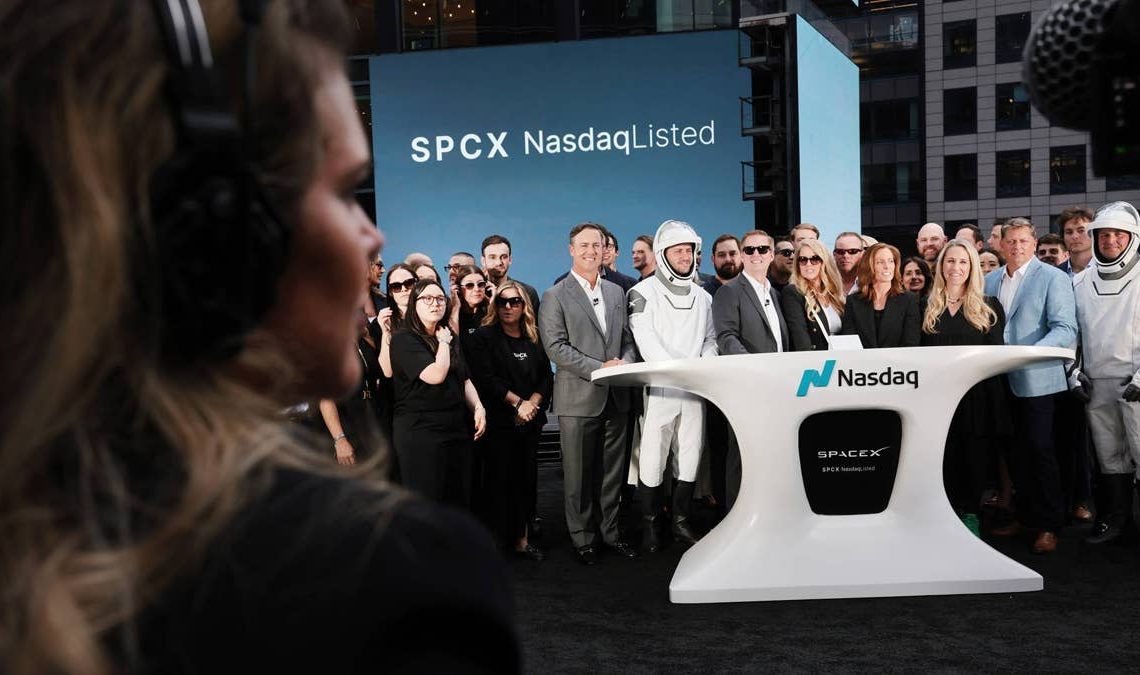
The most immediate cautionary signal came from the largest initial public offering in history. SpaceX listed on the Nasdaq on June 12, opening at $150 per share with a day-one valuation of approximately $1.77 trillion before climbing past $225 per share.
Shares then reversed sharply, falling back to roughly $153 by late June, a collapse of approximately 32% from the peak within just two weeks.
That rapid decline gave OpenAI’s advisers a concrete reference point when they warned Altman that retail enthusiasm for richly valued technology companies may be limited.
Chief financial officer Sarah Friar has advocated for a 2027 timeline, citing $600 billion in future infrastructure spending commitments and the difficulty of meeting public-company reporting standards on a compressed schedule, Tech Times reported.
Spencer Platt/Getty Images
OpenAI’s financials show growth and enormous losses side by side
The financial case for patience has merit, but the numbers also show that the company is spending far more than it takes in.
Audited documents reviewed by the Financial Times showed that OpenAI generated $13.07 billion in revenue during 2025, more than tripling from $3.7 billion the year before.
Total costs and expenses reached $34 billion, driven primarily by $19.18 billion in research and development spending. The operating loss for 2025 was $20.92 billion.
Ross Mayfield, an investment strategist at Baird, argues the AI capex story remains intact despite the OpenAI IPO delay.
“I still over the next 12 months would bet on chip stocks and AI infrastructure stocks outperforming because the demand is just so insatiable,” Mayfield said.
The headline net loss of $38.53 billion includes a one-time, non-cash charge of approximately $41.5 billion connected to OpenAI’s conversion from a nonprofit to a for-profit structure.
HSBC analysts estimate that OpenAI may need more than $207 billion in additional capital through 2030, even under optimistic revenue projections, Tech Times reported.
SoftBank lost $38 billion in market value on the delayed news
The ripple effects were immediate and severe for OpenAI’s second-largest external shareholder.
Shares of the Japanese investment conglomerate SoftBank fell more than 12% in a single trading session in Tokyo after reports of a delay emerged, erasing roughly $38 billion in market capitalization.
SoftBank has committed approximately $65 billion to OpenAI and holds a roughly 13% stake.
The timing creates a collision between a market event and a debt deadline because SoftBank took on a $40 billion bridge loan to fund its OpenAI commitments, with repayment due in March 2027.
A public listing would have provided the exit needed to manage that obligation, Tech Times reported.
A separate $6 billion margin loan that SoftBank sought, using its OpenAI stake as collateral, has stalled because lenders could not determine a reliable loan-to-value ratio without a public market reference price.
Anthropic adds new pressure
OpenAI is also contending with competitive and legal headwinds that could complicate any listing, regardless of when it happens.
Rival Anthropic, founded by former OpenAI researchers, closed a $65 billion funding round in late May at a valuation of $965 billion, surpassing OpenAI’s last private mark by $113 billion.
The company has also filed confidentially for its own public offering and has projected that second-quarter 2026 revenue will reach $10.9 billion, exceeding its end-of-2025 annualized run-rate of roughly $10 billion.
More AI:
- Goldman Sachs has blunt message for AI stock investors
- Microsoft CEO sends a blunt warning on AI and the tech ecosystem
- The next AI infrastructure race has nothing to do with chips
On the legal front, a coalition of 42 state attorneys general served OpenAI with a broad subpoena on June 12, demanding records on advertising, user engagement, data handling, and activities involving minors and seniors.
Companies approaching an initial public offering must disclose material legal risks, and a multistate investigation of that scope would qualify as such.
Analyst Nate Elliott of eMarketer has described OpenAI’s listing position as arriving at a precarious moment, Tech Times reported.
Prediction markets now price OpenAI’s listing for early 2027
The company has not publicly commented on The New York Times report, and no listing date has been confirmed.
Traders on prediction market platform Kalshi now assign a 59% probability that OpenAI will formally announce its initial public offering by March 1, 2027, with odds climbing to 73% by June of that year, CNBC reported.
Earlier contracts had placed the chance of a 2026 listing at only 30% to 40% before the latest report shifted expectations.
Goldman Sachs and Morgan Stanley remain the company’s advisers, and the listing process could resume quickly if conditions stabilize. OpenAI acknowledged the uncertainty in its original June disclosure, noting that going public may take a while.
Related: SpaceX acquires Anthropic and OpenAI rival in $60B deal