
Neither Wall Street nor Main Street wants to hear this.
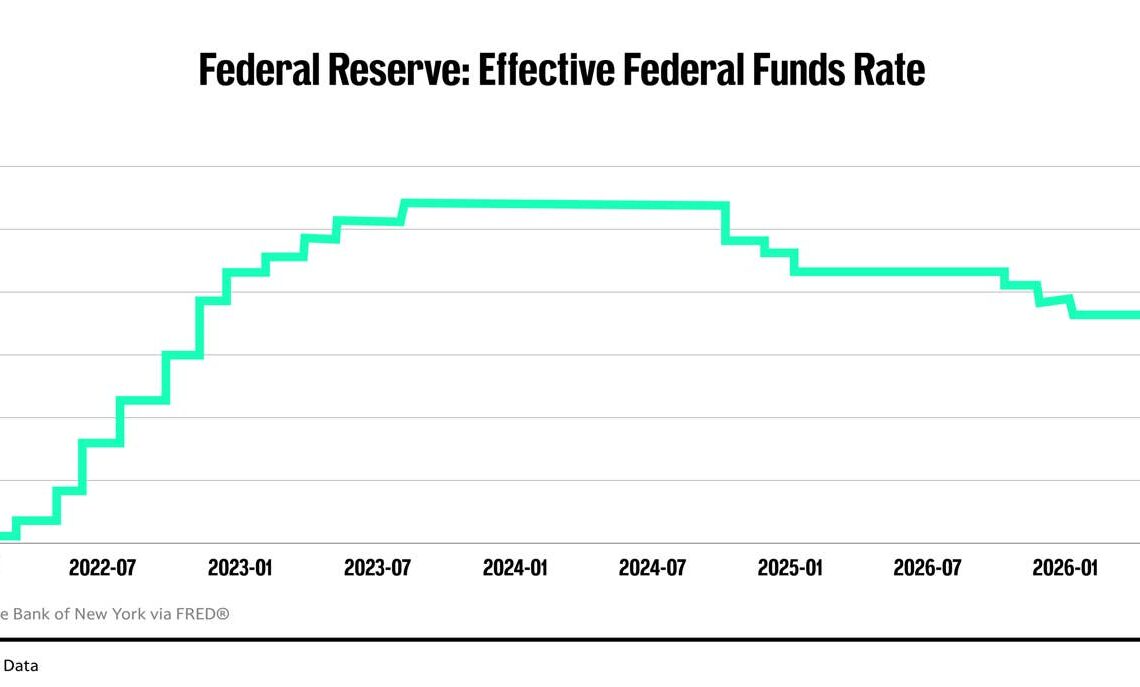
J.P. Morgan Global Research has dropped a sobering message and reversed its “one and done” forecast on Federal Reserve interest-rate hikes. The Wall Street brokerage now calls for two additional increases, plus one in December, to tame persistent price pressures amid higher short-term borrowing costs.
This means consumers and businesses can expect the interest rates on credit cards, student loans, and home-equity loans to rise through early 2027, and indirectly, mortgage rates and Treasury bond yields will also be influenced.
As for investors, higher interest rates ripple through the stock market and investor portfolios via several core channels ranging from discounted cash flows and corporate borrowing costs to shifts in asset allocation.
Back in September, I reported that J.P. Morgan economists called for only one additional 25-basis-point-rate hike by the central bank to curb sticky inflation fueled by the energy shocks from the Iran War and the supply-demand dynamic of artificial intelligence.
But in a Nov. 19 client note obtained by Reuters, J.P. Morgan economists call for additional 25 basis-point-rate hikes at the Federal Open Market Committee’s January and March meetings.
“These hikes aren’t to deliver a bad labor market, but to preserve credibility when they have no compelling narrative for a pause,” J.P. Morgan strategists led by Michael Feroli said.
This falls in line with what other Fed watchers and even what Fed officials are signaling: inflation is coming in way too hot. It’s not only time for higher interest rates, but these hikes may in fact be overdue.
“The labor market has not been a source of inflationary pressure, and yet inflation remains elevated,” J.P. Morgan said, adding it expects modest, positive job growth next year.
J.P. Morgan calls for three consecutive Fed rate hikes
Brokerages BofA Global Research and Deutsche Bank also expect the central bank to increase the benchmark federal funds rate by 25 basis points at each of its next three meetings.
Fed Chairman Kevin Warsh’s decision to dispense with forward guidance to markets after taking over the role in May has left the U.S. monetary policy path without an “overarching narrative,” J.P. Morgan said.
Forward guidance is a communication tool that the Fed used to signal the future path of monetary policy and interest rates to the public and financial markets in order to influence economic behavior and manage expectations.
“Without a narrative as a pole star, policy is more likely to be reactive to incoming data,” J.P. Morgan said.
TheStreet
Hopes for Fed rate cuts in 2027 dim
As I reported, minutes from the Federal Open Market Committee October meeting released Nov. 18, along with some very pointed public remarks from top Fed officials, show the U.S. central bank is becoming increasingly alarmed that price pressures are moving away from its 2% target, but there’s a wide range of opinion within its ranks as to the best approach to lower price pressures.
For investors, businesses and consumers, the emerging consensus signals that hopes for interest-rate relief in 2027 have all but evaporated.
In fact, when the FOMC held its benchmark short-term interest rate steady at 3.75% to 4% in October with a divisive 10-2 vote, the minutes show several participants described the pause as a “close call.”
Fed officials warn price pressures are too hot
The CME Group’s FedWatch Tool projects roughly a 100% probability of a rate hike at the FOMC December meeting, a 48% probability of another in January 2027.
The FedWatch Tool puts the probability of another 25-basis-point raise at the FOMC’s March 2027 meeting at approximately 58%, suggesting traders increasingly expect additional monetary tightening early next year.
At that point, traders expect the federal funds target range will have reached 4.25% to 4.50%.
Related: Fed rate-cut hopes for 2027 take a stunning turn
Four Fed Governors — Vice Chair Philip Jefferson, Michael Barr, Lisa Cook and Christopher Waller — signaled decidedly hawkish tones in the past week, expressing that further tightening of policy was necessary to bring inflation back to its 2% target — a goal the central bank has missed for nearly six years.
Waller doubled down on his comments earlier this month, saying that rising price pressures call for a jumbo 50-basis-point rate hike in December.
“You might need to, like, shock people,” he said in a Nov. 18 CNBC interview.
Warsh vows the Fed is committed to price stability
Warsh has repeatedly said that the Fed is committed to its dual mandate: use interest rates and balance-sheet policy to keep prices stable and the labor market at full employment.
Chicago Fed President Austan Goolsbee, who will be a voting member of the FOMC in 2027, said in a Nov. 19 conference call with reporters that he will consider all options when policymakers meet again Dec. 8-9 to set interest rates. He did not push back against the possibility of a larger-than-usual interest rate increase.
“The AI boom is contributing to the potential of overheating in the economy. I find it hard to…look at that any other way,” Goolsbee said. “When you’re getting major business investment, almost unprecedented levels of business investment, there’s a high danger that the economy’s capacity cannot handle that kind of a pig through the python.”
Trump repeats demand for drastic Fed rate cuts
President Donald Trump has been criticizing the Fed for nearly a decade for not lowering interest rates to 1% or lower.
He repeated his demands during a press conference Nov. 20, saying interest rates are high because the central bank’s leaders are “too political.”
“Whenever we announce good numbers, they raise the rates. They do that for a reason,’’ Trump said. “They do that to destroy the country.”
The growing prospect of another round of interest-rate increases keeps the independent central bank on a collision course with the Trump administration’s calls for cheaper borrowing costs.
For consumers, businesses and investors, the message from Wall Street is becoming increasingly difficult to ignore: The era of waiting for lower interest rates may take longer than anyone wants.
Related: BofA warns new Fed rate-hike cycle packs a very nasty twist