
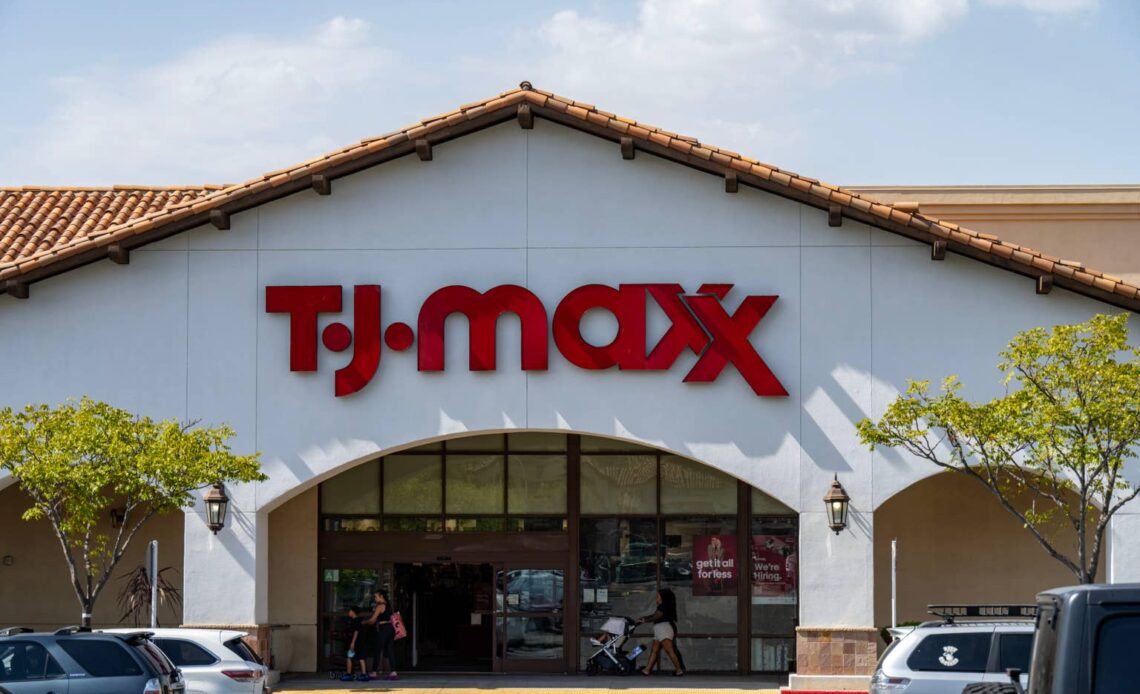
Stand in the snaking checkout queue at virtually any discount store this fall, past the impulse racks of Italian olive oil, scented candles, and discounted winter coats, and it’s nearly impossible to tell who’s struggling and who’s thriving.
Someone clutching a $29 cashmere sweater could be stretching a squeezed paycheck or simply refusing to pay the department store markup for the same label.
That everyday scene is perhaps at the heart of one of Wall Street’s loudest debates. For months, economists described America as a “K-shaped” or two-speed economy, where affluent households spend comfortably while lower-income families have had to pull back.
In fact, earlier this year, Bank of America analysts described the U.S. economy as two separate economies in their midyear outlook, calling it “reflation for higher income, stagflation for lower income.”
Yet during the TJX Companies (TJX) Q3 fiscal 2027 earnings call on Nov. 18, CEO Ernie Herrman offered a snapshot that complicates that tidy divide.
What Ernie Herrman actually said about shoppers across income groups
“In the current environment, we believe value will be top of mind for many consumers this holiday season,” CEO Herrman said in his prepared remarks.
“We’ll be a great destination for consumers who are looking to buy for everyone on their shopping list while staying within their budget.”
More Retail:
- Struggling home goods chain closing more stores
- Verizon makes changes to be more like T-Mobile used to be
- Home Depot drops generous offers as customers grow harder to win
Still, when probed by Telsey Group analyst Dana Telsey for an update on household income levels and whether shoppers were shifting across TJX’s “good, better, best” price tiers, Herrman’s answer pushed back against the idea of a split inside company stores.
“We have not seen a dramatic shift in terms of our sales trend by income group,” Herrman told analysts. “They are all performing at a level balanced with where they would have been a year ago. I think some slight tweaks, but nothing of substance across the board.”
Chief Financial Officer John Klinger backed up that picture with division-level figures. Across Marmaxx, TJX’s flagship U.S. division covering TJ Maxx, Marshalls, and Sierra, which posted $9.33 billion of the company’s $15.95 billion Q3 net revenue, comparable sales rose 2% on top of a 6% gain a year earlier.
“We saw comp sales growth across all regions and income demographic bands,” Klinger reported. This helped lift consolidated comparable sales by 4% and adjusted diluted earnings per share by 5% to $1.34 (or $1.39 unadjusted, including a 5-cent net tariff-refund benefit).
Trevor Srednick / Getty Images
Why balanced off-price sales complicate, but don’t erase, the K-shaped divide
At first glance, balanced growth across all income tiers seems hard to reconcile with broader economic data.
Moody’s Analytics estimated that the top 10% of earners accounted for nearly 50% of U.S. consumer spending in 2025. Similarly, government numbers show everyday budgets remain under pressure.
The Bureau of Labor Statistics reported consumer prices climbed 0.4% in October after a 0.6% jump in September, with groceries up 0.4% and electricity up 0.9%. Even Census Bureau data released Nov. 17 showed October retail sales inching up just 0.2% to $748.2 billion.
A March 2026 review by the Federal Reserve Bank of Minneapolis already cautioned that household spending data doesn’t always align perfectly into a neat “K.” And TJX’s results show why a single checkout line can hide very different financial realities.
Two shoppers could be in the same checkout line at TJ Maxx for very different reasons.
One could be stretching a paycheck by buying everyday items like snacks or shampoo. Another might have more room in the budget but still prefer to buy designer brands or holiday gifts at a discount.
Sales grew across income segments in the division that includes TJ Maxx and Marshalls. Even though it shows strong bargain appeal to shoppers across income levels, it doesn’t indicate whether all of them can spend freely.
The hidden cracks inside TJ Maxx’s own numbers
That said, TJX’s earnings call also showed that higher sales don’t always mean more shoppers are buying.
Comparable sales at Marmaxx, the U.S. division that includes TJ Maxx and Marshalls, rose 2% compared with a year earlier. CFO John Klinger said shoppers spent more per purchase, but “customer transactions were essentially flat.”
At TJX International, which covers Europe and Australia, comparable sales rose 8%, primarily due to higher transaction volume. Across TJX, home categories outperformed apparel during the quarter, and comparable sales at HomeGoods rose 5%.
CEO Ernie Herrman said TJX is watching what rivals charge. When competitors lowered prices in certain categories, TJX cut its prices to remain competitive. That’s exactly what the two-speed economy label can miss.
Households don’t always have the same room in their budgets, but they can still shop at the same stores for deals. Sales grew across income groups at Marmaxx.
That shows the appeal of a bargain, not whether shoppers were buying out of necessity or simply looking to save.
Related: Billionaire Stanley Druckenmiller issues blunt warning on stocks and Fed rate hikes