
Companies repurchase stock when they’re feeling optimistic about the future prospects of their company. Amazon is no exception, and the world’s biggest online retailer has bought back billions of dollars’ worth of shares in recent years. With a market capitalization of more than $2.5 trillion, and hundreds of billions of dollars in sales generated, Amazon is a tech-sector powerhouse.
Here’s how much Amazon has repurchased in stock.
How much has Amazon repurchased in stock?
Since Amazon went public in 1997, it has implemented only one stock repurchase program.
Its sole stock repurchase program was a $10 billion buyback announced in March 2022, when the stock had slipped from record highs. As of 2025, it said it had $6.1 billion in buybacks remaining, and the buyback program has no expiration date.
Related: Amazon’s dividends and stock splits: What you need to know
Why does Amazon repurchase its stock?
Amazon may be feeling optimistic about its future as it buys back shares. The retailer may repurchase stock, typically when share prices are low, as part of a plan to reward employees for meeting company internal performance-based goals.
After a company buys back its own stock, the shares are transferred to treasury stock. The company can then issue stock options or restricted stock units (RSUs) to employees as part of a compensation plan, and those shares typically come from its treasury stock.
When those shares become unrestricted, they then form part of the company’s outstanding stock.
Treasury shares and stock awards
After buying back stock in 2022, Amazon recorded common stock repurchases of $6 billion, and its treasury stock rose to $7.837 billion from $1.837 billion in 2021, according to its 2022 annual report.
In 2024, Amazon awarded a total of 117 million shares as part of compensation to its four top non-CEO executives: Brian T. Olsavsky, chief financial officer; Matthew S. Garman, CEO of Amazon Web Services; Douglas J. Herrington, CEO of Worldwide Amazon Stores; and David A. Zapolsky, chief global affairs and legal officer.
How do Amazon shareholders benefit from stock repurchases?
Buying back stock also dilutes a company’s outstanding shares. A smaller number of outstanding shares could boost earnings per share.
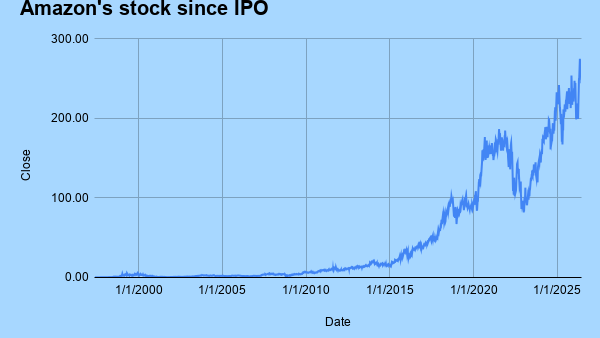
Still, buying back stock puts Amazon in a conundrum. When Amazon announced its repurchasing plan in 2022, it was also implementing a stock split, and share prices were down from their record highs set in 2021 — slipping in January 2023 to their lowest since 2010.
From 2023, the stock was on a rebound — setting record highs starting in 2024, and those high prices made it costly for Amazon to repurchase shares.
Google Sheets via Google Finance
More on Amazon:
- How many employees does Amazon have in 2026? Its workforce explained
- Where are Amazon’s headquarters? Seattle and beyond
- History of Amazon: From garage startup to tech titan
Why doesn’t Amazon buy back all the shares remaining in its repurchase plan?
Money used for repurchasing comes at an opportunity cost. Amazon has spent billions of dollars of profits investing back into its businesses, especially in artificial intelligence, which can be capital-intensive.
The money generated could easily go toward buying back the remaining shares under its repurchase plan, but Amazon has been prudent. Of the nearly $140 billion in cash from operating activities in 2025, the company spent $128 billion to buy property and equipment.
When the $6.1 billion in remaining share purchases will be executed remains to be seen.